"The disruptions triggered by the COVID-19 pandemic pushed
the Washington State food system close to—but not over— the brink
of failure,"
concludes the USDA-funded study conducted by the University of Washington's School
of Public Health & Center for Public Health Nutrition.
The report titled The State of the Washington State Food System During COVID-19:
Taking Stock and Looking Ahead posits that "Market
closures and the need for quick and major food production and food supply chain
pivots revealed weaknesses in existing systems, including a
lack of flexibility and lack of diversification in sales channels for some sectors
and the vulnerability of the just-in-time model for supply chains."
Operational costs jumped, and revenues decreased for many agricultural producers.
Increased demand for local products due
in part to disruptions in national supply chains also exacerbated existing stress
points around infrastructure limitations, especially related to
slaughter and meat processing facilities." As a result, "those marketing
food locally and regionally noted increased customer support and interest
in local foods in the form of increased customer base and strengthened customer
relationships, efforts by community members to support local
producers, and expressions by customers of feeling safer or more confident in
locally grown products."|
Many instances of farmers and producers making concerted efforts to continue
serving customers despite those disruptions exist and continue
to this day. Two such examples are spotlighted in this edition of our menu: Heritage
Meats, in partnership with Harlow Cattle Co. who has been
our primary source of pasture-raised, grass-fed beef since 2010; and, Chimacum
Valley Grainery, who remarkably grow the grains to harvest,
malt, mill, brew and bake at their grainery on the Olympic Peninsula.


HERITAGE MEATS
Rochester,
WA
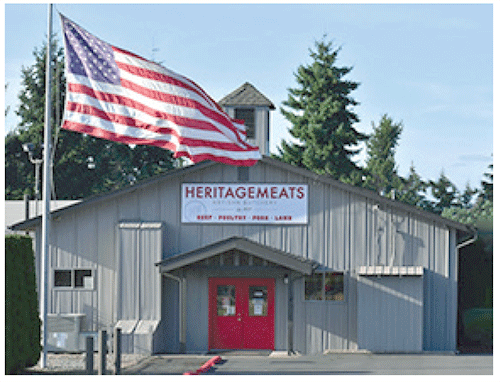
Quite awhile ago I sat with Jonathan Transue, to learn more about
Heritage Meats and Puget Sound Processing. Transue has been at the head of operations
for both facilities for a number of years now. Having grown up farming a small-acreage
plot on Whidbey Island growing beef, pork, chicken and rabbit, he was no stranger
to animal husbandry and butchering. Transue later graduated from the University
of Washington in 2007. After a managerial stint at Washington's corporate Nordstrom,
he took over the reins at Heritage Meats in 2019.
Heritage Meats has been a neighborhood
butcher shop selling farmraised local meat and minimally processed meat products
since it was established as a family-owned business in East Olympia in 1977.
The production facility and retail store have become a local attraction nestled
along the railroad tracks next to Highway 12 in Rochester, WA. From their grass-fed
and grass-finished beef, to their robust artisan sausage and smoked meat selections,
the Heritage Meats team seeks to produce the best taste, quality, and integrity
available to its customer base.
To achieve this, they partner with small producers
that meet standards for quality and consistency to ensure a diverse but consistent
supply.
In collaboration with Puget Sound Processing (PSP), a local animal harvesting
facility that was first constructed as a mobile trailer, Transue and his team
experienced firsthand how the beef, pork, lamb, goat, and poultry are handled
at harvest. Transue was instrumental in developing and obtaining certification
for the construction and use of the facility's Robust Humane Handling System
under the supervision of the USDA's Food Safety and Inspection Service. Working
the system, originally designed by Dr. Temple Grandin, the harvested animals
are not subject to sources of agitation throughout the entire process.
Deteriorating
agricultural infrastructure and few options for USDA certified meat processing,
drove Pierce County Conservation District to develop the USDA Mobile Meat Processing
Unit in use today by PSP. With only a handful left of operating USDA certified
facilities throughout Washington, PSP grants many local, small to mid-size producers
access to USDA processing and therefore to local retail markets.
Prior to the
COVID-19 pandemic Heritage Meats sold approximately fifty per cent of its production
to restaurants and commercial cooperatives in the greater Olympia, Tacoma, Seattle
and Kitsap markets. Those accounts kept them busy, under USDA supervision, meat
cutting and packaging 5 days per week and harvesting (meat slaughtering) 3 days
per week. Their delivery truck was always on the road.
During the pandemic, facing
the near complete loss of restaurants, and other market channels, Heritage Meats
had to pivot their marketing focus or face income losses or business closure.
Walk-in retail sales saw unprecedented interest. The pandemic triggered consumer
awareness about food supply chains and a desire to support local and regional
food. Consumers across Washington State reduced their spending on food-away-fromhome
by more than half.
To service Heritage Meats new walk-in customers, Heritage
Meats tripled their retail display cases and increased their retail store hours.
Accordingly, states their new head of operations, Amie Gardner, the public has
responded. Throughout the change up Heritage Meats was able to prevail through
the pandemic without any employee furloughs or lay-offs. See more at heritagemeatswa.com
Chimacum Valley
Granery
Chimacum, WA
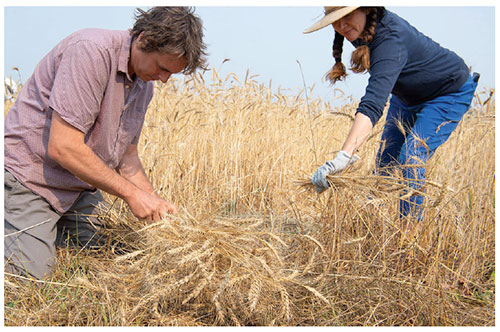
The ever-popular, first-generation Finnriver Farm & Cidery
on the Olympic Peninsula is generally known for its orchards and heirloom cider.
Keith and Crystie Kisler are among Finnriver’s founders. However, their
current focus is growing local grains nearby, just off Center Valley Road within
sight of the cidery. |
|
Chimacum
Valley Granery cont.
Crystie relates, “A few weeks into the pandemic, I turned to Keith
with a question about local food security. Keith reassured me that we had plenty
to eat as the barn had 100,000 pounds of grain. The ensuing flour shortages made
me very motivated to think about how we could make this resource available to
the community, understanding that we were in new terrain regarding food systems’ resilience
and stability.”
Growing up in Eastern Washington near Othello, farming grain has been a constant
in Keith's life. He was part of his family's fourth generation of Eastern Washington
wheat farmers, and he was accustomed to tractors and combines trammeling through
wheat fields during harvests. He studied Environmental Sciences in Boulder, CO,
and met his future farm-wife while teaching in Yosemite. Together, Keith and
Crystie arrived to farm in Chimicum Valley in 2004, starting with apples and
blueberries.
The Kisler's Chimacum Valley Grainery is an organic farm, stone
mill, malthouse and bakery that holds most all of their work efforts today. In
collaboration with researchers at WSU Bread Lab and the Sustainable Seed Systems
Lab, Keith and Crystie grow and mill heirloom and modern grains that have been
selected and farmed for restored nutrition, full flavor and climate resilience.
Most all of the grains used in their bakehouse and brewery come from the 180
acres which they lease within walking distance. They are serious about planting
maritime- hardy, climate-adaptive seed, seeking, without the use of GMOs, an
alternative to the commodified ways of farming and thinking that have stripped
wholeness from our soils and our nutrition.
In response to the pandemic induced
shortages, The Kislers launched a Community Supported Agriculture (CSA) program.
It provided subscribers with an array of 3-pound paper bags each month, with
selections like whole-wheat all-purpose flour, bread flour, pastry flour, and
milled buckwheat, rye and spelt. The CSA boxes also included sacks of wheat berries,
the edible portion of wheat kernels, encompassing the entire germ, bran and endosperm.“This
was a storage form of food security," Crystie states. Stashing away a bucket
of berries is a way to plan for future shortages as the whole berry maintains
all of its nutrition. She muses, “It is a little apocalyptic of me to say,
but it would be OK if people had a few bags of these things in their pantries.”
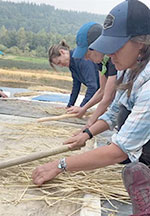
All
along, the Kisler's have worked to revive the place-based practice of wiser agriculture — when
farmers selected and grew locally adapted 'landrace' crops at a community scale
to feed those they lived amongst with a celebration and reverance for the land.
According to Keith, although there have been grains grown on the north Olympic
Peninsula for feedstock, their grainery is likely the only commercial grain produced
for human consumption. "I always felt I would grow grain, wherever I was.
And, I wanted to do things sustainably,” he says. “The more food
we can provide locally is always a good thing to help buffer the larger political
and environmental movement and conditions around the world.”
Currently,
the Grainery mills over 160,000 pounds of grain annually. Nearly seventy-five
percent is sold to commercial bakeries in Port Townsend and Seattle. The remaining
grains are warehoused and utilized in their wood-fired bakery ovens, stone mill,
pasta-making machines, malting floor, and brewing vats. While the CSA is no longer
available, You may purchase their wares online at chimacumgrain.com or locally
at the Chimacum Corner Farmstand and Bay Hay & Feed.
|
|
|
|